Data centres
Construction and commissioning power during the build, and behind-the-meter storage for resilience and demand management once the facility is live.
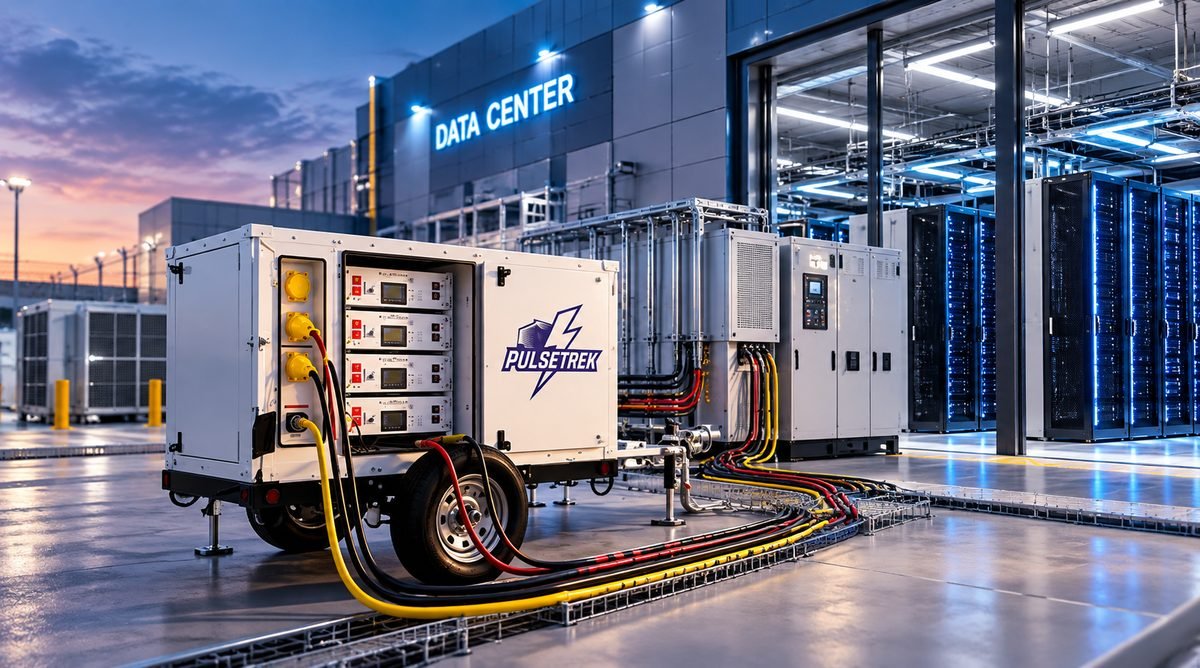
A data centre has a power problem during construction and a different one in operation. During the build, the permanent supply is not energised and the site runs on temporary generation for months — offices, lighting, tools, security and the fit-out trades.
In operation, the facility has UPS and standby generation for outages, but that infrastructure does nothing about demand charges, nothing about generator testing noise, and nothing about the load profile of a facility still filling its halls.
Mobile and containerised storage covers both. During the build it replaces or supplements temporary generation. Afterwards it supports peak shaving, load shifting and resilience — and it is an asset that can move to the next phase of the campus.
On site
Sizing
| Deployment | Typical load | Recommended system |
|---|---|---|
| Site offices during build | Cabins, lighting, security | PulseTrek Base+ — 30 kWh |
| Fit-out and trades | Tools, task lighting, higher draw | PulseTrek Performance — 8 kW |
| Commissioning support | Test loads, sustained draw | Multiple units |
| Operational resilience and peak shaving | Facility-scale | Containerised BESS to 8.3 MWh |
Why it matters here
The system that powers the build becomes the system that shaves peaks, instead of leaving site with the hire fleet.
Temporary generation is usually the noise complaint on a data centre build, particularly on campus sites near housing.
Less test running and fewer starts, which matters where local consent limits running hours.
Behind-the-meter storage flattens the demand component of the bill as the halls fill.
Removing diesel from the construction phase is a measurable, defensible reduction.
Containerised systems scale to 8.3 MWh and move to the next phase.
Questions answered
Yes — most directly during construction and commissioning, where temporary generation runs for months at low average load. In operation, storage reduces generator test running and supports the load rather than replacing the standby plant.
No. UPS exists to bridge the instant of transfer for critical IT load and is engineered for that. Mobile and containerised storage addresses construction power, demand charges, resilience support and generator runtime — a different set of problems.
It depends entirely on which problem you are solving. Construction offices need tens of kWh; peak shaving on a live facility is a megawatt-hour-scale conversation. Send us the interval data and we will size it.
Get in touch
Tell us the site, the load and the runtime you need. Our Austin engineering team comes back with a configuration, a runtime estimate and a price.
+1 512-316-7347
info@pulsar.industries
WhatsApp +1 512-585-8293
