Healthcare
Cold chain, clinical equipment and lighting held through an outage — silently, with no carbon monoxide risk, and without parking a generator outside a ward window.
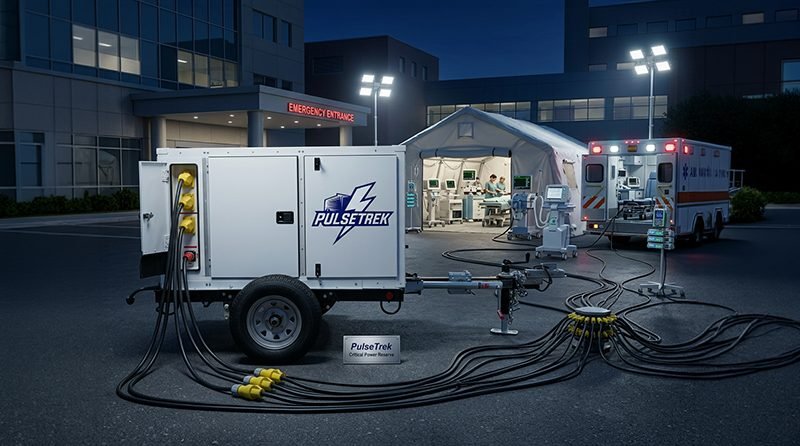
The two constraints that define healthcare backup are carbon monoxide and noise. A combustion generator must sit outside, clear of air intakes and openable windows, which often means a long cable run from wherever it can legally stand — and in a mobile or temporary clinical setting there may be nowhere that qualifies at all.
Noise is the second constraint. Wards, consulting rooms and recovery areas are not places where a diesel set can run for days.
A PulseTrek has neither problem. It produces no emissions in operation, uses LFP chemistry that is highly thermally stable, and makes no noise — so it can be placed inside the space it is protecting.
On site
Sizing
| Deployment | Typical load | Recommended system |
|---|---|---|
| Single clinic or pharmacy | Cold chain, lighting, comms | PulseTrek Base — 15 kWh |
| Mobile medical unit | Equipment, lighting, climate | PulseTrek Base+ — 30 kWh |
| Larger facility, critical loads | Multiple circuits, higher draw | PulseTrek Performance — 8 kW |
| Hospital wing or field hospital | Sustained multi-load | Containerised BESS |
Why it matters here
The single reason a generator cannot be placed indoors simply does not apply.
Wards, recovery and consulting rooms stay usable through a multi-day outage.
Refrigeration is a low continuous load, which is exactly where a battery runs longest.
During the weather events that cause long outages, fuel delivery is the thing that fails.
Stable output without the voltage behaviour of a lightly loaded engine.
PulseTrek kept medical facilities running when Hurricane Harvey took down the Texas coast grid.
Questions answered
Yes. PulseTrek produces no emissions in operation and uses LFP chemistry with no thermal runaway risk, so unlike a diesel or propane generator it can be operated inside clinical and enclosed spaces. Installation must still follow the electrical codes that apply at the facility.
Refrigeration is a relatively low continuous load, which is the profile a battery serves best. A 30 kWh pack will hold cold chain and lighting well beyond a typical outage, and up to seven days at genuinely low load.
In a mobile, temporary or smaller facility it can be the primary backup. In a large hospital with an installed standby plant, it is normally specified for critical sub-loads, for cold chain, or as a silent bridge that removes generator starts.
Get in touch
Tell us the site, the load and the runtime you need. Our Austin engineering team comes back with a configuration, a runtime estimate and a price.
+1 512-316-7347
info@pulsar.industries
WhatsApp +1 512-585-8293
