Emergency response
Rapid-dispatch battery power for storms, outages and disaster relief — with no fuel runs on flooded roads and nothing to refill while the emergency is still running.
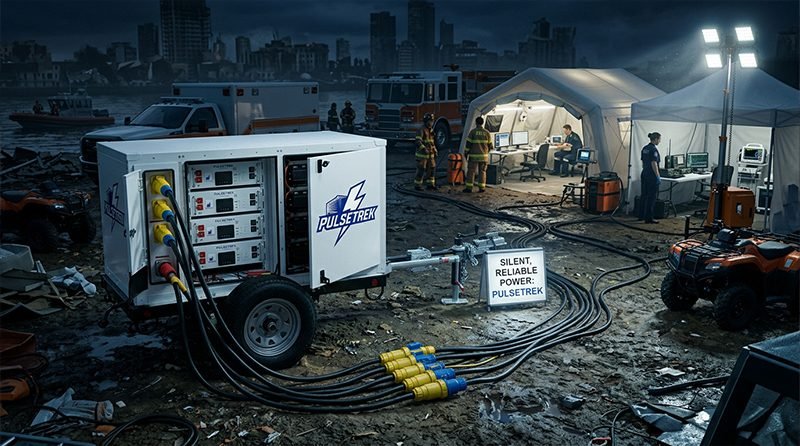
A standby generator is only as good as the next fuel delivery. In the situations that actually cause long outages — hurricanes, floods, ice storms, wildfire — roads are closed, fuel depots are down and the delivery you planned on does not arrive.
When Hurricane Harvey took the grid down across the Texas coast, PulseTrek systems kept medical facilities running. There was no refuelling to arrange, because there was nothing to refuel.
A battery also solves the placement problem. Combustion generators must be outside and well clear of intakes because of carbon monoxide. A PulseTrek can sit inside the building it is powering.
On site
Sizing
| Deployment | Typical load | Recommended system |
|---|---|---|
| Household or small facility | Lighting, refrigeration, comms | PulseTrek Base — 15 kWh |
| Clinic or shelter | Lighting, cold chain, equipment | PulseTrek Base+ — 30 kWh |
| Command post or critical load | Pumps, comms, higher draw | PulseTrek Performance — 8 kW |
| Community-scale response | Multiple buildings, days to weeks | Containerised BESS |
Why it matters here
The one dependency that fails in a disaster is removed. Nothing to deliver, store, guard or pump.
No warm-up, no exhaust routing, no CO monitoring — power is available the moment it is connected.
Zero emissions means the system can sit inside a shelter, clinic or command post.
Shelters and welfare centres stay usable, which matters over multi-day operations.
Designed and assembled in Texas and eligible under the Buy American Act for FEMA and defence buyers.
Grid, generator or solar — whichever is available first.
Questions answered
At low load — emergency lighting and communications — a 30 kWh PulseTrek runs for up to seven continuous days. Higher loads draw the pack down faster, and solar recharging extends runtime indefinitely where the daily draw is within the array's output.
For outages driven by weather and access problems, yes, because the fuel supply chain is the part that usually fails. For very long high-load outages, a hybrid arrangement gives both immediate silent power and unlimited duration.
Yes. PulseTrek produces no emissions in operation and uses LFP chemistry with no thermal runaway risk, so it can be operated inside shelters, clinics and command posts where a combustion generator cannot.
PulseTrek systems are designed and assembled in Texas, making them eligible for federal procurement under the Buy American Act. Documentation of US manufacturing origin is available on request.
Get in touch
Tell us the site, the load and the runtime you need. Our Austin engineering team comes back with a configuration, a runtime estimate and a price.
+1 512-316-7347
info@pulsar.industries
WhatsApp +1 512-585-8293
