Construction
Site offices, welfare units, tools, security and lighting — running clean and quiet, with no generator at the gate and no fuel deliveries in the diary.
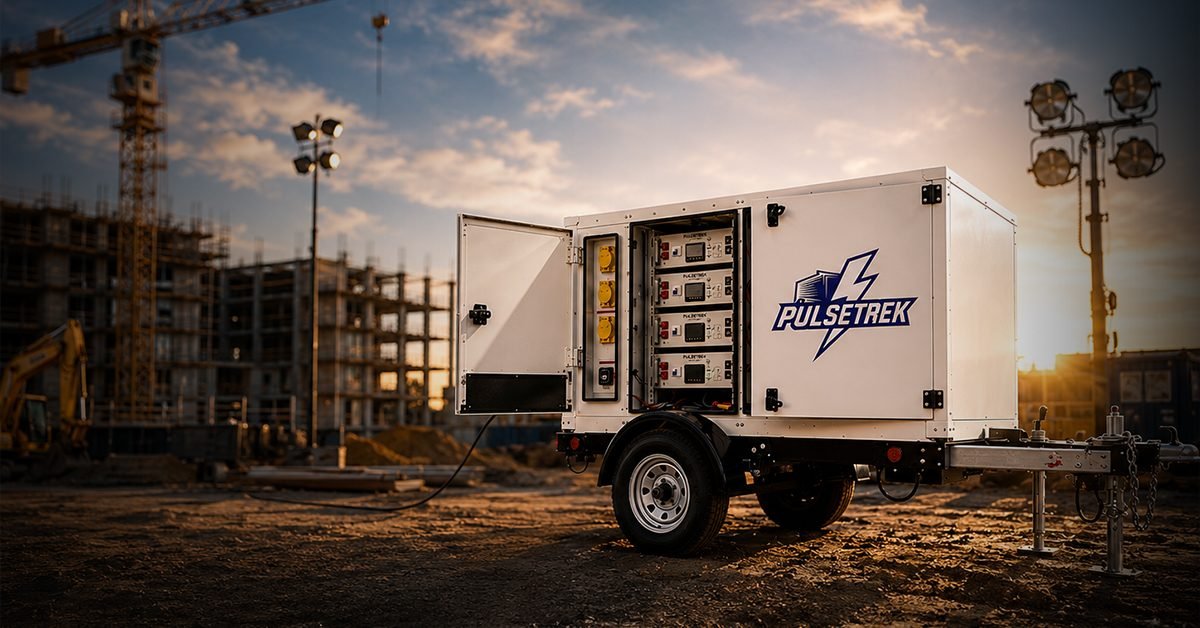
A construction compound is specified for its worst moment — every trailer, every tool and the largest motor starting together. In practice the average draw across a working day is a fraction of that, and overnight it collapses to security, lighting and a fridge in the welfare unit.
A diesel set sized for the peak spends those hours running lightly, which is where it is least efficient and where wet stacking starts. You pay for fuel, for the deliveries, for the refuelling labour, for the servicing and for whatever noise mitigation the local authority asks for.
A PulseTrek covers the same compound from stored energy and recharges when it suits — from shore power once the supply arrives, from the solar kit, or from a right-sized genset that runs a couple of hours instead of twenty-four.
On site
Sizing
A starting point — send us your load list and we will confirm it.
| Deployment | Typical load | Recommended system |
|---|---|---|
| Single trade, small crew | Tools, lighting, one cabin | PulseTrek Base — 15 kWh |
| Medium compound | Two to four cabins, security, tools | PulseTrek Base+ — 30 kWh |
| Large compound, heavier draw | Multiple cabins, three-phase equipment | PulseTrek Performance — 8 kW |
| Multi-trailer village or long build | Whole compound, months on site | Containerised BESS or multiple units |
Why it matters here
No noise ordinance to negotiate means crews are not waiting for a permitted start time to energise the compound.
No tank, no bunding, no spill kit, no delivery access and no theft risk — which removes a whole compliance file.
No exhaust drifting into cabins or across the site, which matters where the compound sits next to occupied buildings.
No oil changes, no filters and no scheduled engine servicing interrupting the programme.
Fit-out and refurbishment work inside a structure can run on battery power, which a combustion generator cannot do.
The rental or purchase figure is close to the total running cost, because there is no fuel line moving with the market.
Questions answered
Yes. A 30 kWh PulseTrek runs a typical construction site for approximately 4 to 8 hours depending on load, and considerably longer for lighter overnight loads such as security and welfare. For a full compound over a long build, systems are either recharged daily from shore power or paired with a right-sized generator.
It depends on the equipment. Hand tools, lighting, site offices, charging stations and small three-phase machinery are well within range — the Performance model delivers 8,000 W continuous and 20,000 W peak. Large plant with high continuous draw is normally run on a hybrid system rather than battery alone.
The biggest single lever is stopping the generator from running at low load. Putting a battery in front of the genset means the generator starts only to recharge and then shuts down, so it runs fewer hours and runs them in its efficient band.
Yes, and often more practical than diesel, because the alternative is trucking fuel to the site. With the solar upgrade kit a remote compound with a modest daily load can run without any fuel logistics at all.
Get in touch
Tell us the site, the load and the runtime you need. Our Austin engineering team comes back with a configuration, a runtime estimate and a price.
+1 512-316-7347
info@pulsar.industries
WhatsApp +1 512-585-8293
