Generator replacement
A diesel set on a temporary site spends most of its life running well below its rating — burning fuel, needing servicing and breaking the noise ordinance to do it. A PulseTrek covers the same load from stored energy.
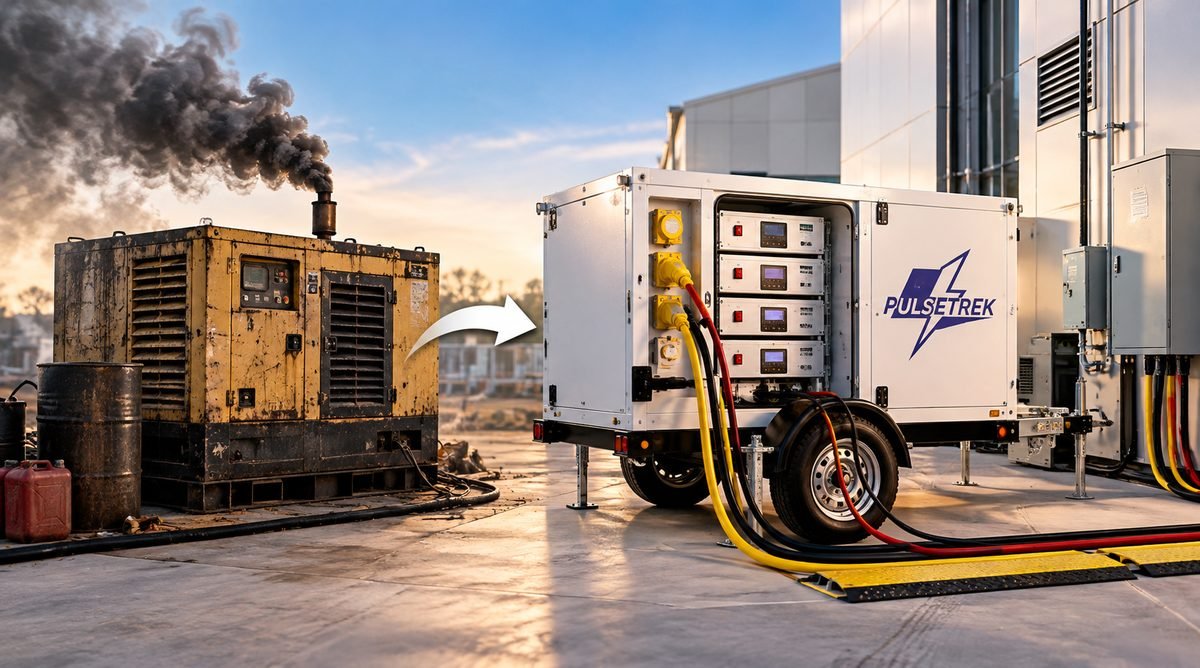
Temporary power is almost always specified for the worst moment — the largest motor starting while everything else is running. That peak might last seconds a day. The generator is then sized for it and runs at a fraction of its rating for the other twenty-three hours.
Diesel engines are inefficient at low load, and running them lightly for long periods causes wet stacking: unburnt fuel accumulating in the exhaust system, which brings extra servicing and shortens engine life. A battery has no equivalent problem — it is as efficient at 10% load as at 90%.
So the comparison is not 'battery versus generator at full load'. It is 'battery at your actual load profile versus a generator that was never sized for it'.
Two ways to do it
The battery carries the site and recharges from shore power or solar. This works where there is a grid connection to top up from, or where the daily load is within what a solar array can replace. The generator leaves site entirely — along with the fuel account, the servicing and the noise.
The battery carries the load and a right-sized generator starts only to recharge it, then drops to standby. Generator runtime falls sharply, the genset runs at its efficient load band while it does run, and you keep full capacity for the worst case. This is the usual answer on high-load or long-duration sites.
Side by side
| On site | Diesel generator | PulseTrek BESS |
|---|---|---|
| Noise | 65–85 dB | Silent |
| Emissions | Exhaust and carbon monoxide | None in operation |
| Fuel logistics | Deliveries, storage, spill kit | None |
| Efficiency at low load | Poor, risk of wet stacking | Unaffected by load level |
| Indoor and enclosed use | Not permitted | Safe |
| Start-up | Warm-up required | Instant, full power |
| Maintenance | Oil, filters, scheduled service | Near zero |
| Crew exposure | Noise and fumes | Neither |
Its rating, its actual load and its hours are enough for us to tell you whether a straight swap or a hybrid is the right answer.
Questions answered
Yes, for most temporary and standby applications. The battery carries the site load and recharges from the grid, solar or a generator. Where the load is genuinely continuous and high, the usual answer is a hybrid: the battery carries the load and a right-sized generator runs only to recharge it.
For the majority of temporary power profiles, yes — they are silent, emission-free at the point of use, safe indoors and need almost no maintenance. Diesel still wins where the load is very large and continuous for weeks with no recharge window, which is why hybrid systems exist.
The saving depends on your load profile: the further your average load sits below the generator's rating, the more there is to recover. On a full replacement the diesel spend goes to zero. On a hybrid, savings come from the generator running fewer hours and running them in its efficient band instead of idling.
Yes. The generator receptacle on every PulseTrek trailer lets an existing genset recharge the pack. The generator then drops to standby while the battery carries the load, which is exactly how generator runtime is reduced without losing capacity.
Whenever noise, emissions, indoor use, fuel logistics or low average load are part of the picture. That covers most construction compounds, events, film units, healthcare settings and unattended telecom or backup sites.
Get in touch
Tell us the site, the load and the runtime you need. Our Austin engineering team comes back with a configuration, a runtime estimate and a price.
+1 512-316-7347
info@pulsar.industries
WhatsApp +1 512-585-8293
