Telecom
Tower and node backup that rides through multi-day outages, reports its own state of charge, and does not need anyone driving fuel out to a remote site.
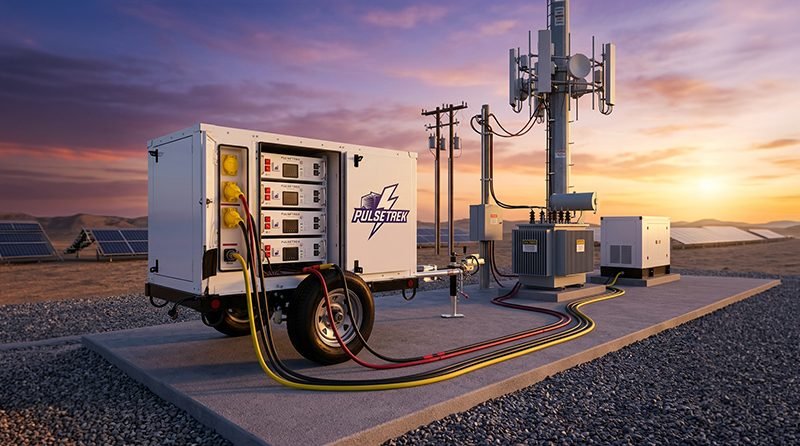
A telecom site's backup problem is rarely the equipment. It is that the site is remote, unattended and one of hundreds — so every fuel delivery, every generator service and every callout is a truck roll with a person in it.
Diesel backup at a remote node means scheduled servicing whether or not the generator ran, fuel that degrades in the tank, and an outage response that begins with a drive.
A battery system with remote monitoring inverts that. It reports its own state of charge and system health, has no oil, filters or fuel system to maintain, and operates from -20°C to +50°C — so a site visit happens when the data says so, not on a calendar.
On site
Sizing
| Deployment | Typical load | Recommended system |
|---|---|---|
| Small node or repeater | Low continuous draw | PulseTrek Base — 15 kWh |
| Standard tower site | Radio plus ancillaries | PulseTrek Base+ — 30 kWh |
| Larger or multi-tenant site | Several operators' equipment | PulseTrek Performance — 8 kW |
| Regional hub | Extended holdover required | Containerised BESS |
Why it matters here
No fuel deliveries and no scheduled engine servicing, which is where most of the operating cost of remote backup sits.
Remote monitoring reports state of charge and system health, so intervention is driven by data rather than a schedule.
Two problems that quietly affect unattended diesel installations disappear.
Safe operation from -20°C to +50°C covers the environments most tower sites actually sit in.
Sites in residential or noise-restricted locations can hold through an outage without a compliance problem.
6,000+ cycles and a 10+ year lifespan warranty against a generator's rebuild cycle.
Questions answered
Telecom loads are relatively low and continuous, which is the profile a battery serves best. Runtime depends on the site's draw, but multi-day holdover is achievable and can be extended indefinitely with solar recharging.
PulseTrek LFP systems operate safely between -20°C and +50°C, which covers the environments most tower and node sites are exposed to.
Yes. Every system includes remote monitoring of state of charge and system health, so the operator sees the site's status without a visit.
Near zero. There is no oil, no filters and no fuel system. The LFP cells are rated for 6,000+ cycles and carry a 10+ year lifespan warranty.
Get in touch
Tell us the site, the load and the runtime you need. Our Austin engineering team comes back with a configuration, a runtime estimate and a price.
+1 512-316-7347
info@pulsar.industries
WhatsApp +1 512-585-8293
