Discover how mobile battery energy storage is changing the way businesses power construction sites, EV fleets, events, emergency operations and remote applications. PulseTrek brings stored energy directly to the point of use.
Industries that depend on temporary or off-grid electricity have traditionally relied on fuel-powered generators. Today, organizations are increasingly looking for power options that can reduce noise, direct exhaust emissions and operational complexity.
Mobile battery energy storage systems help address that need by storing electricity and delivering it exactly where it is required. Instead of depending only on fixed electrical infrastructure, mobile systems can move with changing projects and operating locations.
A mobile battery energy storage system, often called a mobile BESS, stores electrical energy in batteries and supplies that energy to tools, equipment, charging systems and other electrical loads.
The key difference is mobility. A conventional BESS is normally installed at a fixed location, while a mobile system can support temporary projects, changing jobsites and applications where permanent infrastructure may not be practical.
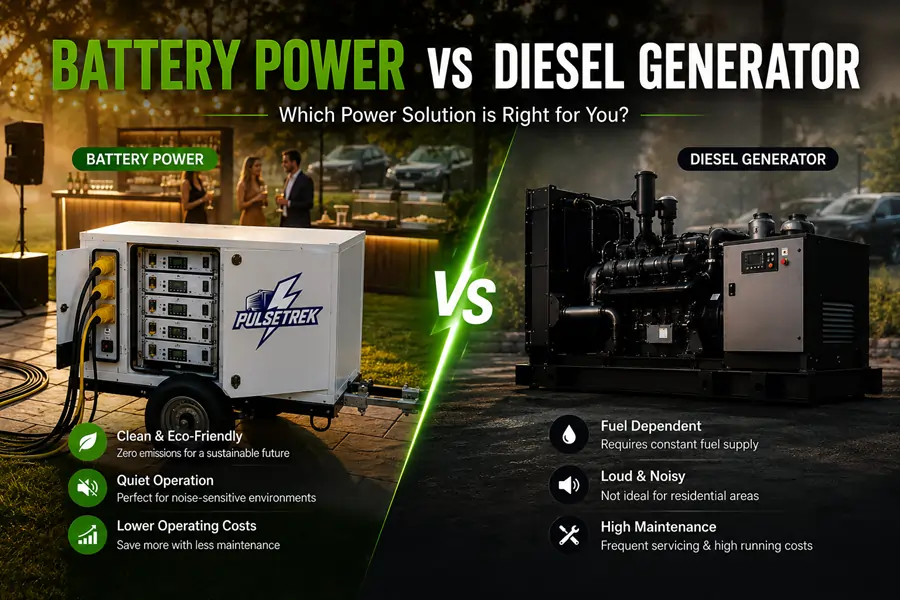
One of the clearest advantages is quieter operation. Battery systems deliver electricity without the continuous combustion-engine noise associated with conventional generators.
They also avoid direct exhaust emissions while operating from the battery, which can be valuable for projects where local air quality, worker comfort and noise-sensitive environments matter.
PulseTrek mobile energy solutions are built around Lithium Iron Phosphate (LFP) battery technology. LFP chemistry is well suited to energy-storage applications where durability, repeated cycling and stable battery performance are important considerations.
For commercial users, battery chemistry is an important part of evaluating the long-term suitability of a mobile energy storage system. The goal is not simply to store energy, but to deliver dependable power across repeated real-world deployments.
Fleet electrification creates a new challenge: getting enough electrical capacity to the locations where vehicles actually operate. Permanent charging infrastructure can be ideal for established depots, but temporary sites and changing fleet locations often need more flexibility.
Mobile battery energy storage can bring stored electricity closer to fleet operations, providing an additional option for organizations evaluating scalable charging strategies.
Explore EV Fleet Charging →
The transition toward cleaner energy is not only about how electricity is generated. It is also about where energy is stored, how it is moved and when it becomes available.
Mobile battery energy storage gives organizations another way to deliver electricity to jobsites, fleets, events, emergency operations and other locations where fixed infrastructure may not meet the requirement.
PulseTrek is focused on making battery power mobile, practical and ready for demanding real-world applications.
A mobile battery energy storage system stores electricity in batteries and makes that energy available at temporary, remote or changing locations where power is needed.
Mobile BESS can support construction, EV fleets, events, emergency response, film and TV production, telecom, utilities and other commercial or industrial applications.
Yes. Depending on the application, mobile battery storage can operate independently or as part of a broader strategy that includes grid charging, solar or generator support.
Tell us your application, required load and deployment environment. Our team can help identify the right PulseTrek mobile energy storage solution.