Telecom & Utilities · Infrastructure Power

Infrastructure Power
That Never Fails.

Reliable LFP battery backup for cell towers, substations, and telecom infrastructure. Silent, zero-emission, solar rechargeable. No fuel logistics. Remote monitoring standard.

Made in USA · Austin TX 0 dB Silent Zero Emissions 6,000+ LFP Cycles
7D
Runtime
Per single charge
Solar Runtime
Off-grid indefinitely
0
Fuel Required
Zero logistics
6K+
LFP Cycles
10+ year lifespan
24/7
Monitoring
Remote WiFi app
-20
°C Min
Arctic to desert
Cell Tower BackupSubstation PowerZero Fuel LogisticsSolar Rechargeable7-Day RuntimeRemote MonitoringIP68 Weatherproof-20°C to +50°CMade in USALFP 6,000+ CyclesCell Tower BackupSubstation PowerZero Fuel LogisticsSolar Rechargeable7-Day RuntimeRemote MonitoringIP68 Weatherproof-20°C to +50°CMade in USALFP 6,000+ Cycles
Why Telecom & Utilities Professionals Choose PulseTrek

Telecom & Utility Battery
Backup Power

Telecom networks and utility infrastructure depend on uninterrupted power to maintain communication, grid stability, and emergency response systems. Even a few seconds of downtime can disrupt cellular networks, internet services, and critical utility operations.

PulseTrek delivers advanced LFP-based backup power systems designed for cell towers, substations, data infrastructure, and remote utility assets. Built for reliability, efficiency, and remote management, PulseTrek replaces traditional diesel backup systems with clean, silent, and intelligent energy storage.
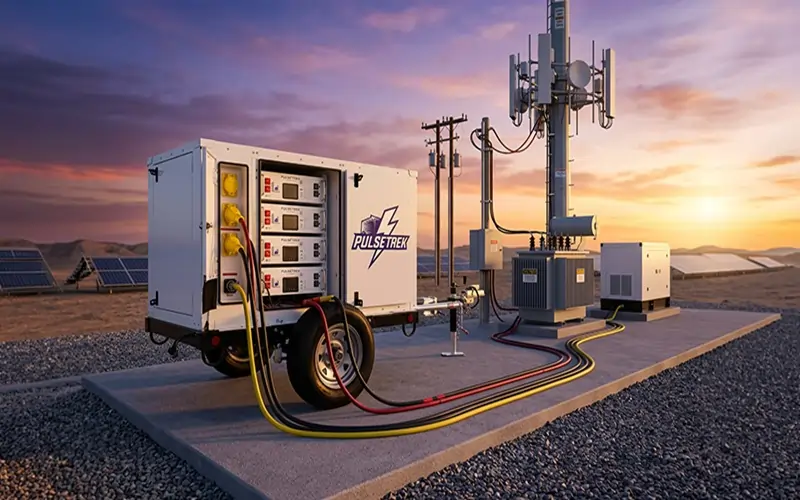
Telecom Utilities Battery Backup Power
24/7

Remote Monitoring Standard

WiFi remote monitoring app standard on all models — track battery level, output power, temperature, and fault alerts from your NOC without site visits. BMS sends immediate fault alerts when any parameter exceeds threshold. Reduces operational cost of monitoring distributed tower sites significantly.

Instant

Instant Failover — No Gaps

PulseTrek switches to backup mode in under 1 second — far faster than diesel generators which take 30–60 seconds to stabilize. For cell towers and network infrastructure, this means zero service interruption during grid transitions. Critical for meeting carrier uptime SLAs.

Solar

Solar: Off-Grid Tower Power

Solar + PulseTrek enables truly off-grid tower operation — no grid connection, no fuel logistics, no monthly fuel delivery scheduling at remote tower sites. Particularly valuable for rural and mountain towers where fuel delivery is expensive and unreliable.

IP68

All-Environment Hardened

IP68 weatherproof, NEMA 3R steel enclosure. Operates from -20°C to +50°C — Arctic tower sites to desert substations. No diesel fuel freezing at cold sites, no engine overheating at hot sites. LFP chemistry maintains performance across the full operating range.

$0

Zero Ongoing Fuel Cost

Diesel generators at telecom sites consume significant fuel — especially during extended outages. PulseTrek has zero fuel cost. With solar, it has zero energy cost. Reduces per-site operational expenditure immediately.

BMS

Intelligent Load Management

Smart BMS automatically manages power distribution to connected equipment, prioritizes critical loads, and maximizes battery runtime during extended outages. CAN and RS485 communication protocols enable integration with existing tower management systems.

Telecom & Utilities Applications

Every application.
Silent power.

01

Cell Tower Backup

Reliable backup power for 4G/5G cell towers during grid outages — maintaining network coverage when communities need connectivity most.

02

Substations

Backup power for distribution substations, switching equipment, and control systems during planned and unplanned outages.

03

Remote Tower Sites

Off-grid power for towers in locations where grid extension is prohibitively expensive or fuel delivery unreliable.

04

Network Nodes

Power for fiber nodes, switching hubs, and network equipment at distributed infrastructure locations.

05

Radio Repeaters

Backup and primary power for radio repeater sites serving emergency communications networks.

06

Utility Monitoring

Power for smart grid sensors, monitoring equipment, and communication systems throughout distribution networks.

07

SCADA Systems

Reliable backup for supervisory control and data acquisition (SCADA) equipment at utility facilities.

08

Emergency Communications

Backup power for first responder communication infrastructure — P25, LTE, and satellite earth stations.

Telecom & Utilities

Reliable backup power for critical network infrastructure.

"
I got an off-grid battery system from Pulsar Industries for my STR, and the whole experience was incredible. Since the consultation through installation, everyone was super professional, responsive, and very knowledgeable about modern energy solutions. The system has been working perfectly so far — dependable power, super quiet, and worry-free. It’s a big improvement over traditional generators, and I now rely on steady energy without the hassle of fuel or ongoing maintenance.
Al PT
"
I own a mobile bar and recently worked an event where Pulsar Industries donated the use of their beautiful work of art they call a generator 😍 It was parked right behind my trailer for the 3 hour event, and no one even knew it was there. It was dead silent, and there was no obnoxious gas smell like I’m used to with generators. It was nice to be able to hear my customers and not have to worry about refilling gas or killing the ambience of the event with my generator noise.
Hannah Revels
Frequently Asked Questions

Common questions from
telecom & utilities professionals.

LFP significantly outperforms lead-acid in every relevant metric. LFP vs VRLA: Cycle life 6,000+ vs 300–500 cycles · Lifespan 10+ years vs 3–5 years · Usable capacity 100% DoD vs 50% DoD · Weight: LFP stores 3× more energy per kilogram · Temperature performance: LFP maintains capacity at -20°C, VRLA loses 50%+ · Maintenance: zero vs quarterly battery checks and water addition. The total cost of ownership advantage for LFP over a 10-year tower lifecycle is substantial.
Yes — CAN and RS485 communication protocols are standard on all PulseTrek models, enabling integration with existing BMS, SCADA, and tower management platforms. The Leberi industrial system also includes Ethernet for full IP-based integration. Remote monitoring data can be fed into your NOC dashboard alongside other site parameters.
Runtime depends on tower load. A typical 4G/5G macro cell draws 2,000–4,000W under load. A 30 kWh PulseTrek provides: 7–15 hours continuous operation at full load · Extended runtime at reduced load during low-traffic periods · Indefinite runtime with solar at sites with good solar resource. For rural towers, solar + 30 kWh is typically sufficient for indefinite off-grid operation.
Yes — operating range is -20°C to +50°C discharge. Desert tower site temperatures regularly reach 45–50°C ambient, which is within PulseTrek's operational range. LFP chemistry maintains stable performance at high temperatures without the thermal runaway risk of older lithium chemistries. The NEMA 3R steel enclosure provides direct sun shielding.
LFP battery systems dramatically outperform diesel over 10 years at telecom sites. Diesel costs include: fuel delivery $5,000–$15,000/year per site · maintenance $2,000–$4,000/year · engine replacement at year 4–5 ($8,000–$15,000) · permit compliance ongoing. PulseTrek: near-zero maintenance, zero fuel, 10+ year battery life. Total 10-year diesel cost: $70,000–$150,000 per site. PulseTrek total 10-year cost: purchase + minimal maintenance.
Telecom & Utilities Power Guide

Complete guide to LFP battery backup for telecom & utilities.

Why telecom operators are switching from diesel to LFP battery backup

The telecommunications industry operates critical infrastructure that cannot fail — and for decades, diesel generators have been the backup power standard. But diesel has fundamental weaknesses that LFP battery systems solve: fuel logistics, engine maintenance, cold-weather fuel gelling, and instant failover capability.

PulseTrek's LFP battery technology switches to backup mode in under 1 second — faster than diesel generators can even start. For cell towers and network infrastructure, this eliminates the service interruption gap that occurs during diesel generator startup.

Total cost of ownership: LFP vs diesel at tower sites

Industry analysis consistently shows that diesel generator operating costs at telecom sites average $8,000–$20,000 per site annually — fuel delivery, maintenance, and periodic engine replacement. Over a 10-year lifecycle, this represents $80,000–$200,000 per site in operational expenditure beyond the initial purchase. LFP battery systems with 10+ year lifespans and near-zero maintenance fundamentally change this economics — particularly when combined with solar for remote sites.

Target Keywords
cell tower backuptelecom battery backupsubstation powerutility backup batteryoff-grid tower powerLFP telecomnetwork backup powerSCADA battery
UPTIME
Get Started

Ready to go diesel-free?

Tell us your power requirements — we'll identify the right PulseTrek system and provide a detailed quote within one business day.

+1 (512) 585-4271
info@pulsar.industries
249 County Road 214, Liberty Hill, USA