Everything you need to know
about construction site battery power.
What is a portable battery power station for construction sites?
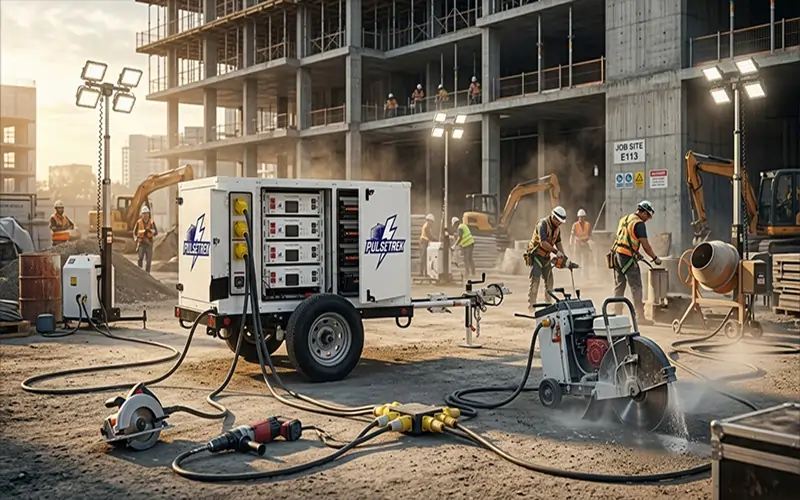
A portable battery power station for construction sites is a large-format rechargeable lithium battery system — typically mounted on a towable trailer — that stores electricity and delivers it through standard AC outlets to power tools, lighting, office equipment, and machinery on job sites. Unlike diesel generators, battery power stations produce zero emissions, zero noise, and require no fuel. They are charged from a wall outlet, solar panels, or an existing generator, then deployed and operated silently on site for hours or days per charge.
PulseTrek is the leading trailer-mounted construction site battery power station manufactured in the USA. With 15–30 kWh of LFP battery capacity and up to 20,000W peak output, PulseTrek handles the full range of professional construction loads — from circular saws and air compressors to site lighting and office trailers.
Why construction sites are replacing diesel generators with battery power
The construction industry is undergoing a significant power transition in 2025–2026. Lithium battery power stations are replacing diesel generators on job sites across the United States for multiple reasons:
- OSHA noise regulations — Diesel generators run at 65–85 dB. Battery systems run at 0 dB, eliminating OSHA 29 CFR 1926 noise exposure compliance requirements.
- EPA emissions regulations — Air quality standards in California, Texas, New York, and other non-attainment zones increasingly restrict diesel generator use. Battery systems produce zero exhaust.
- Indoor and basement work — Diesel generators cannot be used indoors due to carbon monoxide risk. Battery power stations are completely safe in enclosed construction spaces.
- Fuel cost elimination — A 20kW diesel generator running 8 hours/day consumes $15,000–$25,000 in fuel annually. Battery systems have zero fuel cost.
- EV construction equipment growth — Electric excavators, lifts, and vehicles require EV charging capability on-site. PulseTrek includes Level 1 and Level 2 EV charging.
How much does a construction site battery power station cost vs diesel?
The upfront purchase price of a portable battery power station for construction is higher than a comparable diesel generator. However, the total cost of ownership (TCO) reverses this within 2–4 years. Diesel generator purchase price is typically less than one-third of its total lifetime cost — fuel, maintenance, permits, and eventual engine replacement add up significantly.
For a mid-size construction operation:
- Diesel annual fuel cost: $15,000–$25,000/year
- Diesel annual maintenance: $2,000–$5,000/year
- PulseTrek annual fuel cost: $0
- PulseTrek annual maintenance: ~$200–500/year
- Typical annual savings: $20,000–$35,000
Add the 30% US federal IRA Investment Tax Credit for solar + battery storage pairing, and investment payback accelerates further. Most construction operators achieve full payback within 2–4 years.
Is PulseTrek OSHA compliant for construction sites?
Yes. PulseTrek battery power stations satisfy OSHA construction site requirements automatically. OSHA 29 CFR 1926 sets noise exposure limits that diesel generators frequently violate, requiring expensive monitoring programs, hearing protection equipment, and work rotation schedules. PulseTrek produces 0 dB noise — eliminating all noise compliance requirements without any additional measures. The LFP battery chemistry also eliminates explosion and fire risk associated with diesel fuel storage and handling on job sites.
Can PulseTrek power heavy construction equipment?
The PulseTrek Performance Model delivers 8,000W continuous and 20,000W peak power — sufficient for virtually all professional construction loads including:
- Circular saws (typically 1,500–2,400W running, 3,000–6,000W startup surge)
- Air compressors (typically 1,500–3,000W running, 4,000–8,000W startup)
- Concrete mixers, angle grinders, table saws, and impact drivers
- Welding equipment (up to 4,000–6,000W for MIG welders)
- HVAC in office trailers, computers, and communications simultaneously
For the heaviest industrial loads — large crane motors, industrial-scale welding arrays — the Leberi containerized BESS (3.3–8.3 MWh) handles grid-scale construction power requirements.